Summary
For an -sided polygon, the sum of the inner angles is:
If , then we see that the sum of inner angles if , which is a fact I memorized as a student. We first prove this using a triangle, and then discuss how our proof generalizes to all -sided polygons.
Proof
First, consider a triangle described by the points , with respective inner angles . Note that these angles do not necessarily equal each other.
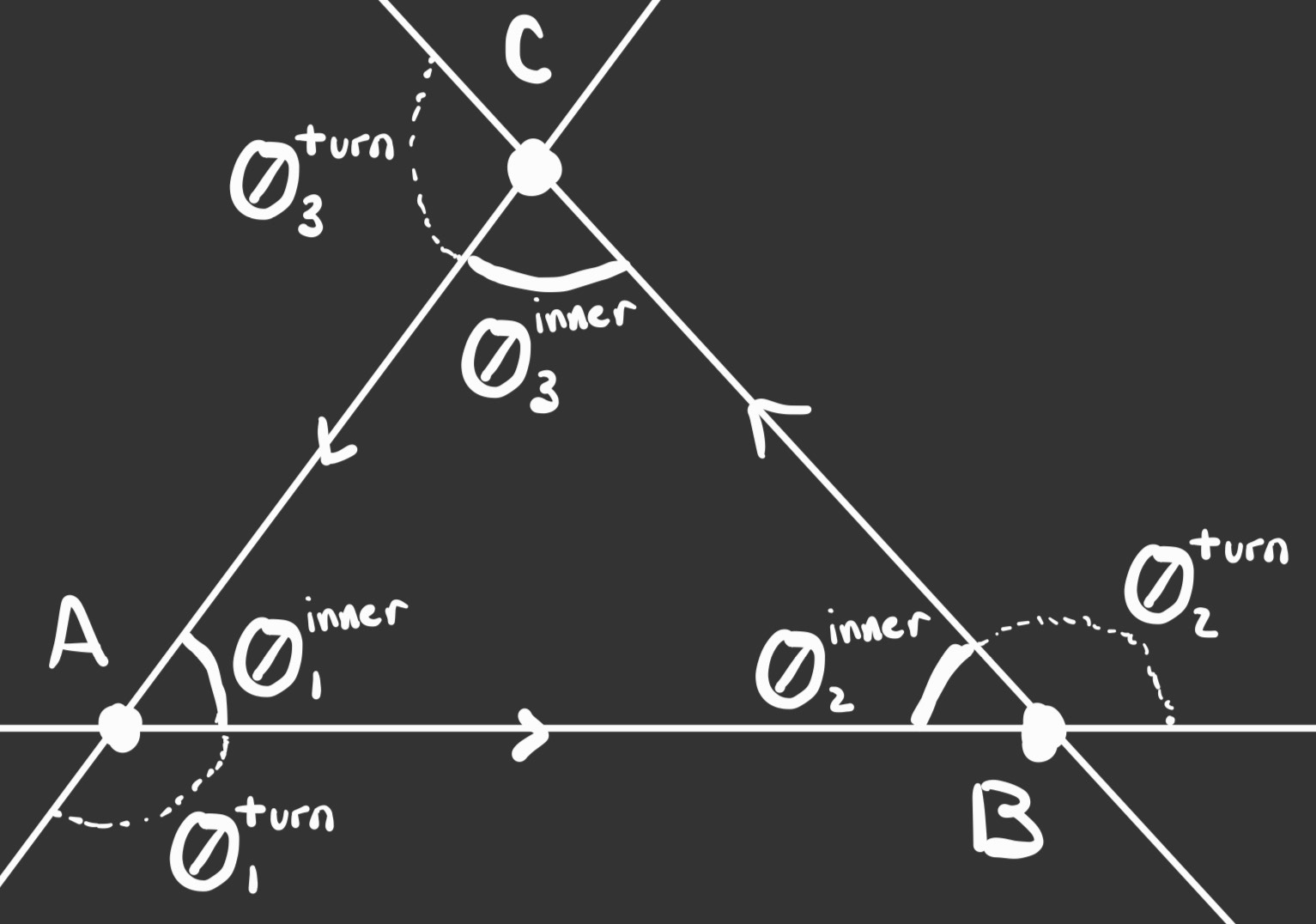
We have also written out the turn angles, , by extending out the lines of the triangle. The turn and inner angles are supplementary, meaning each pair of inner/turn angles sums to :
Additionally, we know the sum of the turn angles equals . We will prove this by considering a person walking the entire perimeter of the shape counter-clockwise (i.e., always heading in the direction of the arrows on the triangle edges), and turning degrees at each point:
- First, the person standing at point , and facing towards point , and the total degrees they have turned is .
- They will walk towards , and then turn towards point by turning counter-clockwise degrees. Therefore, the total degrees turned is now .
- They will next walk towards , and then turn towards point by turning counter-clockwise degrees. Therefore, the total degrees turned is now .
- They will last walk towards , and then turn towards point by turning counter-clockwise degrees. The person has now walked the entire perimeter and turned a total degrees of . Not only is the person back at the starting point after all three turn turns, but they are also facing the same direction they started. Because each turn was counter-clockwise (so each turn positively contributes to the total turn) and that the shape is a polygon (so no lines cross-over), ending up facing the same orientation as we started means the person spun a total of . Therefore, we conclude that:
We can now substitute in our rearranged version of the definition of supplementary angles into the constraint on turn angles equation. Here, I will use to represent the number of sides/inner angles of a triangle:
This is exactly the formula we know and love for the sum of inner angles of a -sided polygon, which gives us the answer for a triangle: .
You’ll notice that our proof above did not rely on anything about the fact that it was a triangle: the triangle just meant that the polygon had sides/angles. Therefore, we can apply our proof to all -sided polygon, which is why we wrote the above derivation with .
Credit
Thank you to Michael Fishman for providing the proof and inspiration to write this note, Zoheb Anjum for additional clarity, and Thao Nguyen for reviewing/make suggestions to this note.